


What Is Infrared Photography?
The Human Eye Cannot See All Light
The human eye is only sensitive to certain wavelengths of light – between 380 and 780 nanometers, which correspond to red, green, and blue.
However, light also exists beyond these wavelengths.
Some Film Stocks Can Capture These “Colors” Invisible to the Human Eye
Certain film stocks are more sensitive than the human eye and can capture light rays beyond 780 nanometers (known as infrared) or below 380 nanometers (known as ultraviolet).
The Artistic Appeal of Infrared Photography
Black and White Infrared Photography
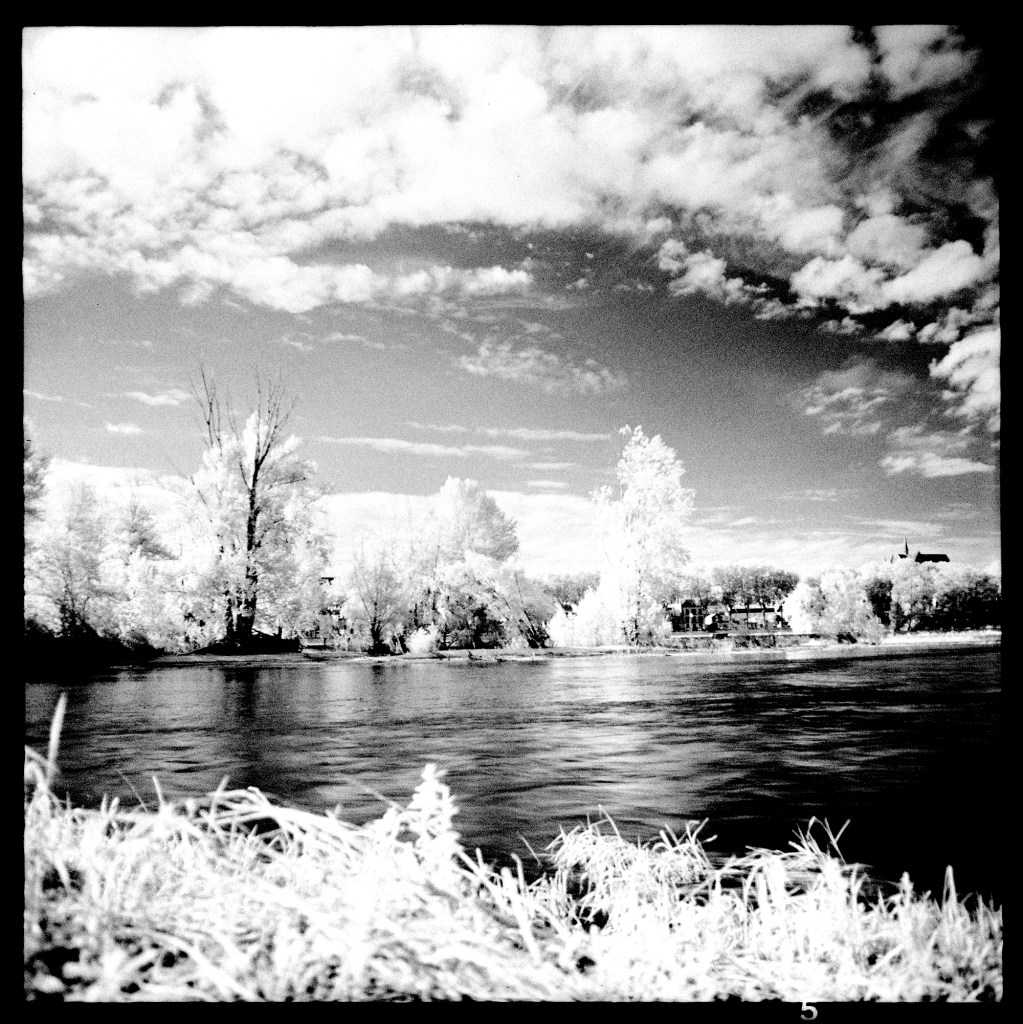
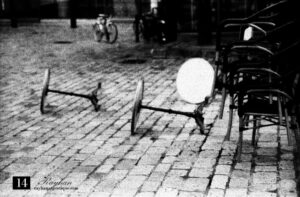
Infrared photography offers a completely different perspective on the world: green foliage turns white while skies become deep black in monochrome images.
Infrared Photography in Color
It is also possible to work in color – but only with a modified digital sensor, since infrared color film is no longer produced.
Because infrared light is invisible to the human eye, visible colors (red, green, blue) are assigned arbitrarily to different wavelength ranges.
For example, wavelengths from 780nm to 820nm may be rendered in red, while 820nm to 860nm could appear blue.
How to Shoot Infrared Photography
Isolating the Infrared Spectrum
Regular film is not designed for infrared photography, but to reproduce an image matching human vision.
To shoot infrared photography, you therefore need film specifically designed to capture infrared light.
However, this film will also capture visible light, which can overwhelm the infrared effect.
You therefore need a way to block the wavelengths that are not useful for infrared photography.
Using a Filter
To isolate infrared light, photographers use a filter that blocks the wavelengths visible to the human eye (typically wavelengths below 780 nanometers).
In practice, most available filters still allow some visible light to pass through and generally block wavelengths below 720nm or 690nm instead.
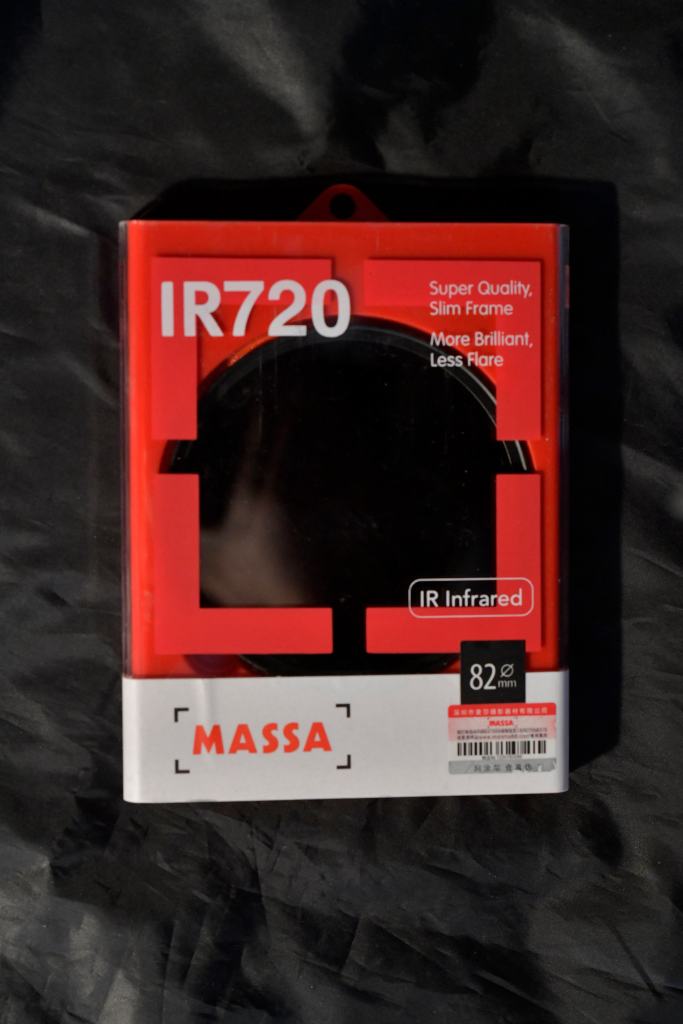
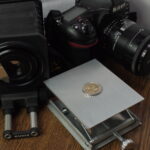
This filter only blocks light below 720 nanometers.
The Limitations of Infrared Photography
Technical Constraints: Infrared Sensitivity
As explained above, the recording medium – whether digital or film – must be capable of capturing infrared light.
Choosing the Right Film
It is therefore essential to use infrared-sensitive film for this type of photography.
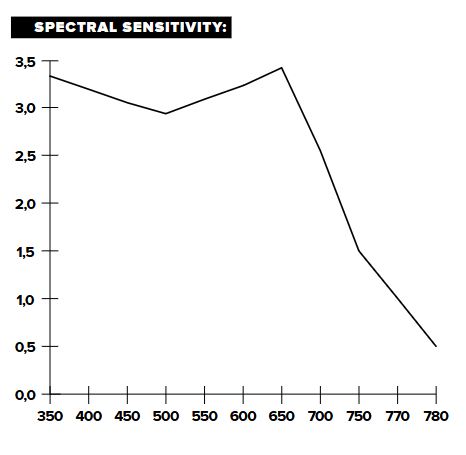
You can usually find this information in the film’s technical datasheet online. In principle, the sensitivity curve should extend beyond 780 nanometers.
Most manufacturers clearly mention infrared capability in the film name itself.
As shown here, Rollei Infrared continues to capture light beyond 780 nanometers.
Heavy Modifications for Digital Cameras
Most digital camera sensors include a filter designed to block infrared light.*
To shoot infrared photography, this filter must therefore be modified or replaced.
This process necessarily requires disassembling the camera.
*Some infrared light can still pass through certain sensors, but removing the filter allows much better results.
Practical Constraints
Long Exposure Times
Handheld infrared photography is possible (and that is what I did to frame the previous photograph in this post).
However, a tripod and exposure times of several seconds are recommended for optimal image quality.
Exposure times vary depending on both the infrared sensitivity of the sensor and the filter being used.
Reflex Cameras Cannot Be Used Through the Viewfinder
Since infrared filters block visible light, you cannot compose an image through the optical viewfinder of an SLR camera while the filter is attached.
A mirrorless camera or a digital camera equipped with live view solves this problem and allows proper framing with the filter mounted on the lens.
Infrared Focus Shift
Standard focus markings on lenses are not accurate for infrared photography.
The focus point must be shifted slightly to obtain a sharp infrared image.
Keep this in mind when shooting with a rangefinder camera or when focusing by distance scale.
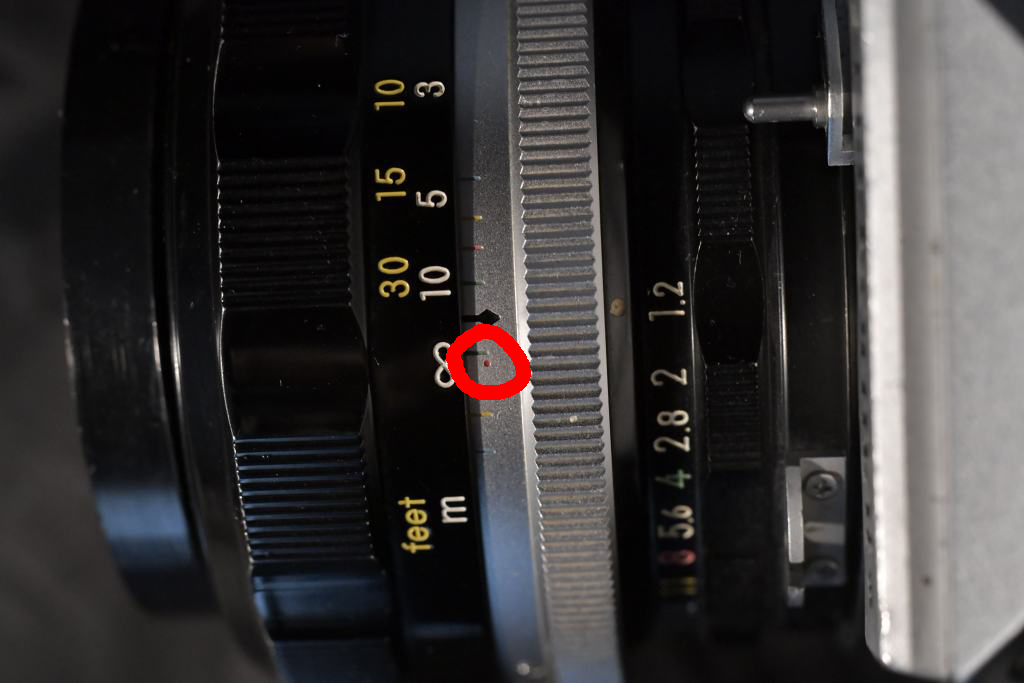
The small red dot corresponds to the infrared focus mark.
Here, the lens is focused at infinity for infrared photography.
Not all lenses include this marking.
Lens: Nikkor 55mm F1.2 SC
Choosing the Right Lens
Some lenses may also produce poor infrared images with a hotspot — a bright circular area in the center of the frame.
Below is a list ranking lenses according to their infrared hotspot performance.










Leave a Reply