



Not the Most Beautiful Camera…
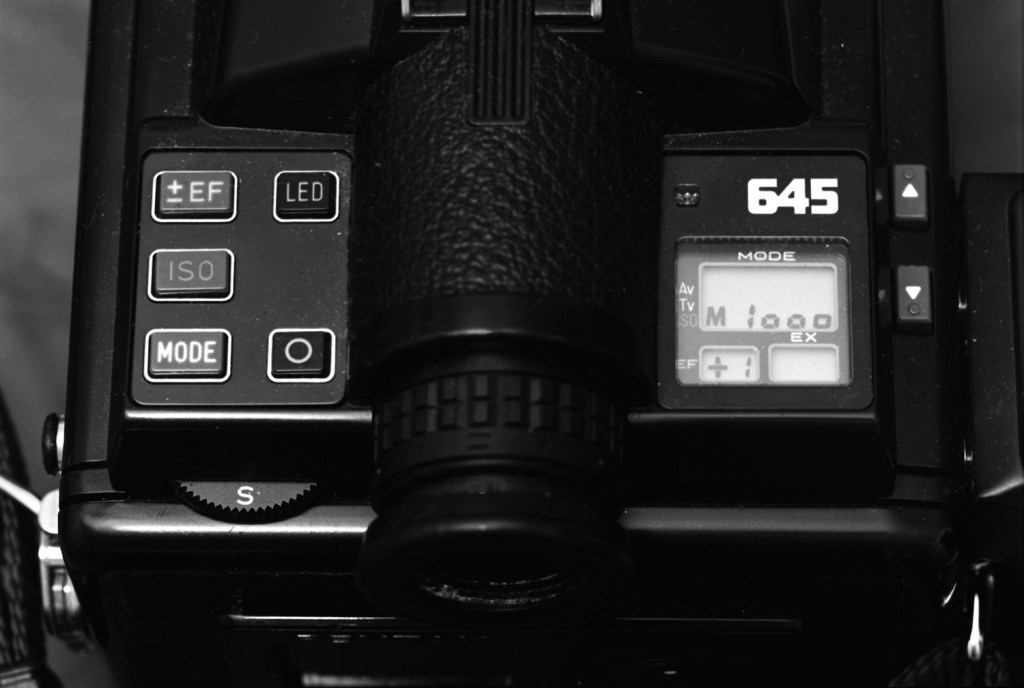
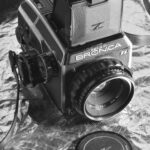
The first thing you notice is that this camera is the complete opposite of the gothic charm of the Pentax Spotmatic (1964–1976) or Pentax 67: it is essentially a large rectangular box with five buttons and an LCD screen, to which a grip and a prism finder have been attached.
…But Practical and Reliable
The Pentax 645 (1984) was my first medium format camera and as a user of 35mm camera I encounter no problem mastering it.
It features the controls and automatic modes you would expect from a 35mm SLR. The only added complexity comes from changing the format 120 film.
The camera is not charming, but is highly functional and reliable.
Otherwise it is a lot heavier than a 35mm camera – 1.3 kg without a lens – because of its film advance motor.
Focusing is manual on this first version, while the film is advanced automatically by a rather noisy motor.
Adapting Lenses From Other Brands
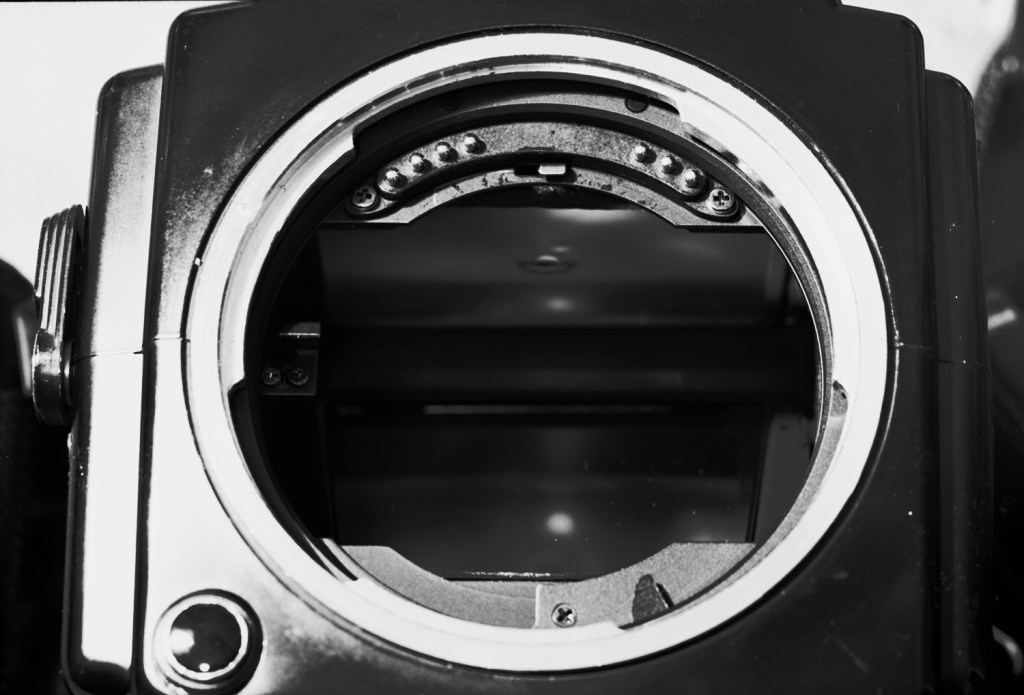
One major advantage – especially if, like me, you do not particularly enjoy the rendering of Pentax lenses – is that its flange distance allows lenses from different mounts to be adapted.
For my part, I adapted a Zeiss 150mm f/4 (Hasselblad V mount) and a Mir 45mm (Salyut mount) using commercially available adapters.
A Camera Build For Professional Use
The Pentax 645 was built for being by profesionnal. It will be especially useful for shooting in studio or wedding photography when taking quickly take a series of shots is necessary.
The autofocus integrated in the next versions of the camera allows you to be even faster and efficient.
Otherwise if you are – like me – a landscape photographer, these functionalities will be no use when not bulky for you.
A malfunction I encountered with the camera
Be careful, however, not to handle it too roughly when loading film, or you might experience the same mishap I did: tear out one of the small cylinder that guides the film, which then causes film flatness issues.




Leave a Reply