

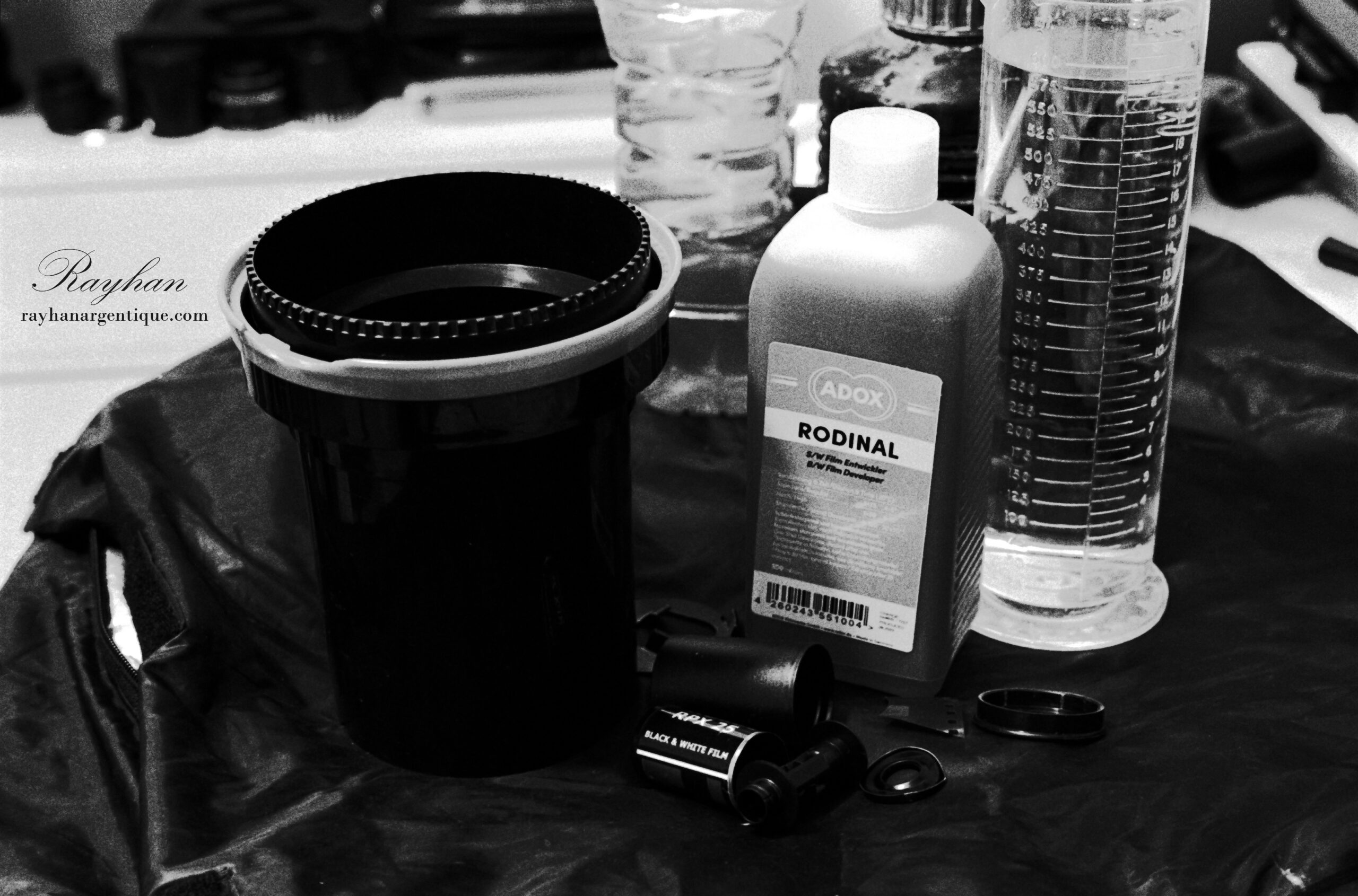

From Latent Image to Visible Image
After taking photographs, the negative still appears transparent. However, the silver crystals have reacted to light and an invisible latent image has formed.
To transform this latent image into a visible and usable image, different chemical solutions are required. The two most important are the developer and the fixer.
The Role of the Developer
The purpose of the developer is to “blacken” or increase the density of the silver crystals that were exposed to light. In other words, it transforms the latent image into a visible image.
There are many developer formulas, but they generally follow the same structure:
Developer Composition
The Two Main Components
The Developing Agent
A developing agent is required to blacken the exposed silver crystals.
Examples of developing agents:
Metol, Hydroquinone, Pyro, Phenidone, Dimezone (Phenidone B), Ascorbic Acid, Vitamin C (X-Tol), p-Aminophenol (Rodinal), Glycin
The Accelerator
To work effectively and blacken the crystals, the developing agent needs an alkaline environment. The role of the accelerator is therefore to make the solution alkaline.
Examples of accelerators:
Borax, Sodium Carbonate, Caustic Soda
Other Components
The Restrainer or Anti-Fog Agent
With only the first two components, development can happen too quickly and become difficult to control.
Unexposed silver crystals may begin to blacken as well, causing fogging on the image.
A third component – the restrainer – is therefore required to control the action of the developing agent and accelerator.
Example:
Potassium Bromide
The Preservative
All these chemical components are vulnerable to oxygen. A fourth component is therefore added to protect them from oxidation.
Example:
Sodium Sulfite
The Water Softener
A water softener is also often included to prevent calcium deposits from forming on the negative.
Example:
Sodium Tripolyphosphate
The Impact of Developer Formulas
On Image Rendering
Even though most developers share the same structure, changing the proportions or selecting different chemicals can significantly alter the appearance of the final negative.
The choice of developer can radically affect image rendering: rough and grainy, or smooth with fine grain; highly contrasted or soft and low-contrast.
On Developer Shelf Life
The storage life of a developer depends heavily on its formula. Rodinal, for example, is famous for remaining effective for weeks or even months after opening, whereas other developers can lose their effectiveness within a few days.
Sources:
https://en.wikipedia.org/wiki/Photographic_developer
https://www.youtube.com/watch?v=FGrYE6rHoWQ
https://argentiquedeuxpointzero.com/le-caffenol-dans-tous-ses-etats-et-3-fausses-verites/










Leave a Reply