



Genesis of the APS format
The creation of the APS format, short for “Advanced Photo System,” originated from Kodak in the late 1980s.
After convincing Nikon, Canon, Minolta, and Fuji to join the venture, the first APS format films and compatible cameras went on sale in 1996.
Why create a new format?
The APS format did not revolutionize film photography. We can see it as a developement of kodak’s original philosophy “You Press the Button, We Do the Rest”.
APS film introduced a technical innovation that offered greater user convenience: the addition of a magnetic strip coated onto the film.
In a nutshell, the magnetic strip on APS film was the predecessor of the EXIF data found later in digital cameras. It also made it easy to swap partially used film cartridges and prevented errors.
This feature allows to:
- Retrieve shooting information so that the date and film identification number will be printed on the back of the prints.
- Retrieve exposure information in the magnetic strip (flash, shutter speed, aperture, chosen aspect ratio) to be interpreted by an algorithm to produce the best possible print.
- Avoid errors: no more unwanted multiple exposure. The camera knows if a film has already been used.
- Reuse film easily: when you rewind and reinsert a film, the system automatically returns you to the shot you left off on.
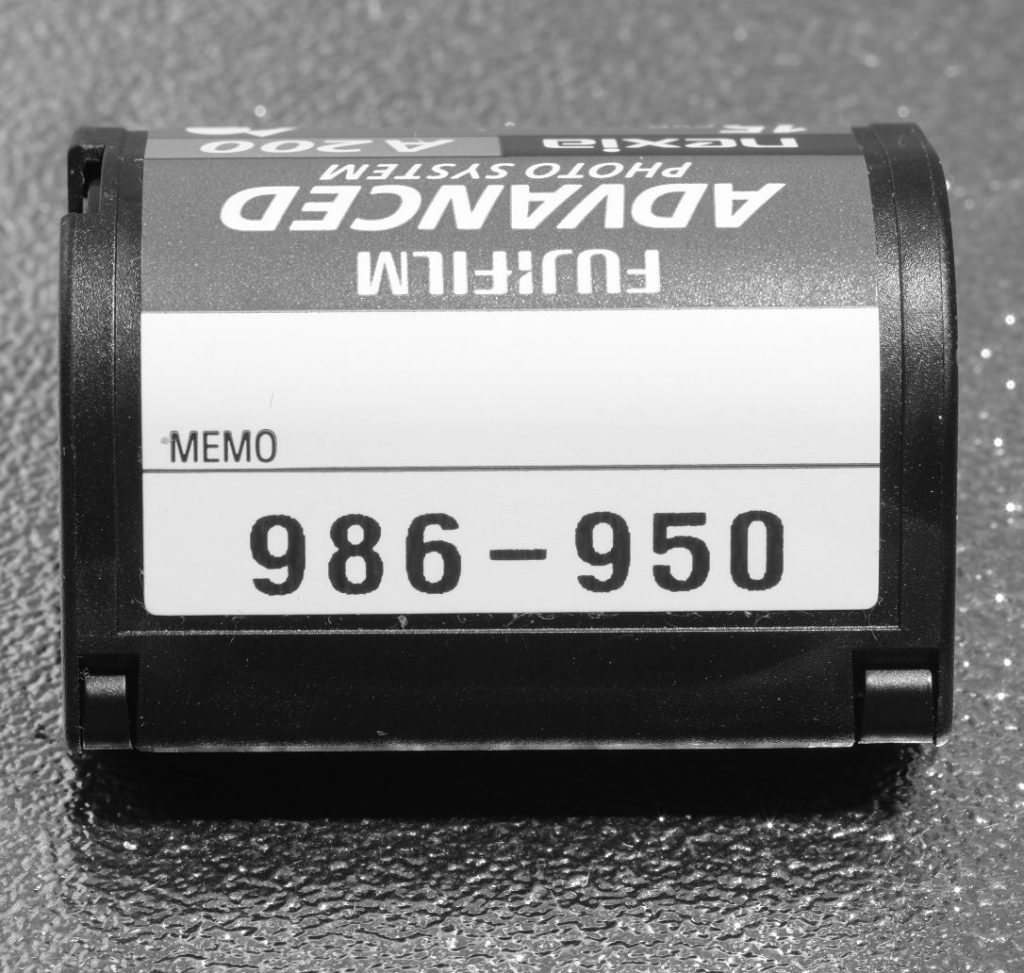
The number on the film allows you to easily match a film with a print.
An automated and closed processing system
APS film is designed to be processed in a developing machine. You won’t find a reel to slide your APS film into a developing tank (you’ll have to improvise).
Once the film is developed, the frames aren’t archived in a binder, but are transferred back onto the film canister making archiving easier.


Symbols under the film indicate its progress.
Intended for casual photographers

Ease of use is the main advantage of the APS format.
Replacing APS film on a Canon EOS IX7.
With only 58% of the surface area of a 35mm film and the resulting loss of definition, the APS format clearly failed to win over professional photographers.
The use of APS format was mainly limited to inexperienced photographers who could benefit from the format ease of use.
A stillborn format
In 1997, Kodak announced that the introduction of the system had required an investment of $500 million. A very poor investment, considering that film sales would continually decline in favor of digital from 2001 onward.
Not so innovative compared to classic 35mm film, and quickly facing competition from digital cameras that were even simpler to use and increasingly cheaper, APS film failed to achieve success and production ceased in 2011.
The reason why the 35mm format survived is that those who still used film after the digital revolution were amateurs and professionals.
These people preferred the higher definition of 35mm. They didn’t bother developing their film themselves, and were not interested in having an algorithm decide the rendering of their photos.
While casual photographers who were only looking for a simple and economical solution logically chose digital over the APS format.
The legacy of the APS format
Cameras produced for this film are therefore now only collector’s items.
And as for the lenses used by those cameras, most of them were electronically controlled. So, they are very difficult to adapt on other cameras.
However, the name “APS” survived and was adopted for the APS-C digital sensor format, as the two formats have approximately the same image area.
Sources :
https://en.wikipedia.org/wiki/Advanced_Photo_System#cite_note-PopPhoto-9604-roar-8
https://web.archive.org/web/19991103001906/http://www.kodak.com/global/en/consumer/APS/redBook/aboutSystem.shtml
https://en.wikipedia.org/wiki/You_Press_the_Button%2C_We_Do_the_Rest












Leave a Reply