

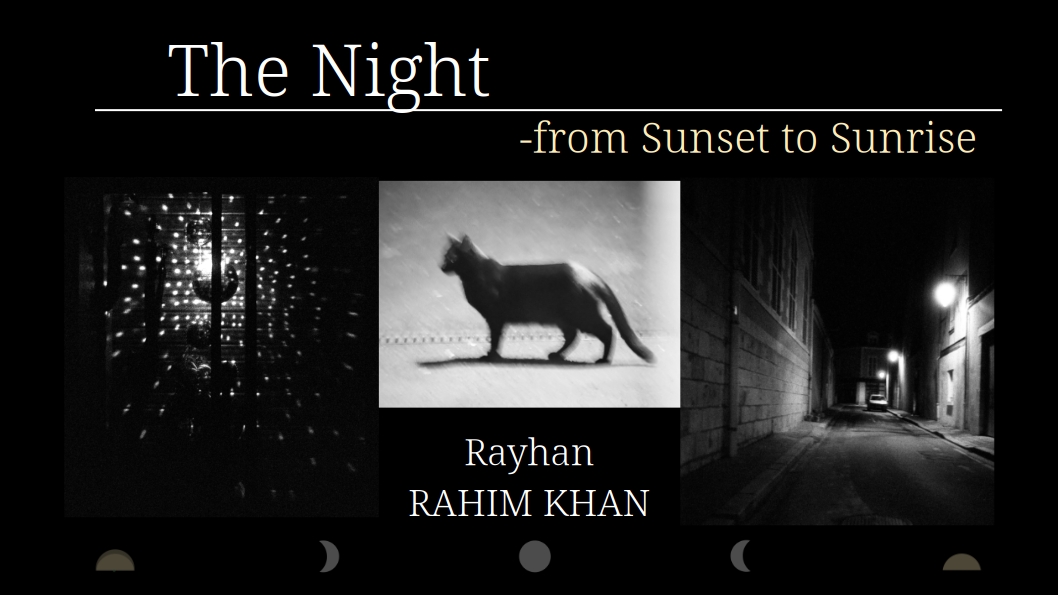

Hello, I am Fine Art Photographer Rayhan Rahim Khan and I just published a photo art book named “The Night” which features 95 photographs. I thought it would be interesting to share the creative process behind this project. You can view the book by subscribing to ElectroCroissant for $8 per month.
The Idea of Creating a Photo Book
Back when I was starting out on my journey as a fine art photographer in 2021, I already liked photographing at night. It offered a calm environment where I could take my time to experiment.
Over the years, this habit of shooting at night stayed with me. In fact, if you asked me whether I’ve spent more time photographing during the day or at night, I wouldn’t be able to answer. So it is no surprise that after accumulating all these nocturnal shots, I decided to put them in a book.
The book I wanted to create
Photographers such as Brassaï, Michael Kenna and others have already treated the theme of the night. My goal was not to copy them, but to tell the story of the night in my own way. In fact, I did not even consult their work before creating this book.
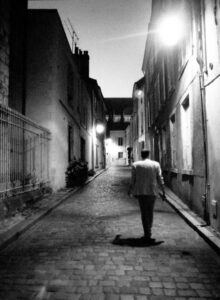
I wasn’t interested in creating a book that would be a simple compilation of my best photos. What I wanted was to create a narrative experience that translated the feeling of walking through empty streets at night.
For the book’s format, I decided to publish it exclusively as a digital edition, accessible on my website, ElectroCroissant.
After these first decisions, most of the work was still ahead. The next step was to figure out how to create a coherent story from these thousands of night shots.
The structure of the book
The solution I found was to arrange the photos chronologically, based on the time of night when they were taken. Thus, the book would be divided into several chapters, tracing a journey from the sunset, through the different phases of the night, to the sunrise.
The book would tell how the passage of the hours impacts the world, from the streets filled with people at sunset, to those quietest instants at the middle of the night, to the first people going to work before daybreak.
The universal story of the passage of time perfectly fits my photographic style. I am always removed from the action in a contemplative approach. This connection between the structure and the photo style gives the book its coherence.
I took most of the photos in Orléans, but some of them in Paris. The photos were also taken across different seasons. For another story, this heterogeneity could have been a flaw, but there this diversity reinforces the universal character of the book’s story.
It took a lot of time and many iterations to seamlessly sequence the 95 photos.
And I am very pleased with the final result. It is a long uninterrupted sentence from sunset to sunrise that makes us read the book in one sitting. Beyond the quality of the photos and atmosphere, that precise and carefully arranged sequence of images is what makes this book stand on its own.
The difficulties in creating this book
As this is my first book, there are some flaws.
A raw rendering
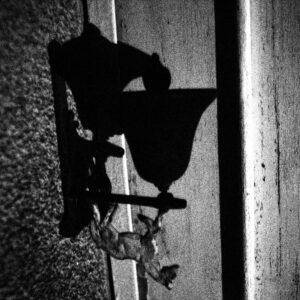
The quality of the photos is imperfect. I shot most of them handheld at high ISO, which creates grain and motion blur. But in the end I don’t think it penalizes the book. On the contrary, it emphasizes this eerie feeling of walking through empty streets in the middle of the night. Photos that are too clean and too sharp would have ruined this effect.
Matching the rendering
I took most of these photos without thinking of creating a book. I was just going out at night, photographing whatever I found interesting. The idea came later, after seeing the amount of images I ended up with.
That meant that the photos were taken with different focal lengths and sensors. Fortunately, my photographic style didn’t change during this period, which helps keep unity between the photos.
So the challenge was to ensure a consistent rendering across all the photos. As most of my pictures were already in analog black and white, I just converted the color ones to monochrome to unify them. If needed, I would also adapt a photo (cropping and tonality) to better fit it into the flow of images.
In the end, I think it turned out quite well, at no point the reader feel distracted by differences in rendering across the images.
An imperfect layout
Even if I am satisfied with the rhythm and the photos in the book, I think a lot of other details, such as the layout, could be refined. But as I am quite inexperienced in photo book design, I currently lack the knowledge to perfect everything.
A good book
Overall, I think nothing prevents the viewer from enjoying the book. It has a strong coherence, given by the selection of the 95 photos and the way they flow together+. I am quite proud of the final result and I am sure you’ll like it too.
The book is exclusively available to ElectroCroissant subscribers. I hope you’ll enjoy viewing it as much as I enjoyed making it.

Leave a Reply